sciensano.be
Published on sciensano.be (https://sciensano.be)

Home > Biblio > Characterization of the TiO2 E171 food additive

Characterization of the TiO2 E171 food additive

Food consumption and food safety  
[1]
Download 591.89 KB [1]

Public Access

Published

Scientific poster, presentation or proceeding

English

SCIENSANO

Authors

Frederic Brassinne [2]; Jan Mast [3]

Keywords

    Article written during project(s) : 
    To²DeNano Towards a toxicologically relevant definition of nanomaterials [4]
    Nanofood@ Implementation and validation of an analytical methodology to assess the nanofraction in the food additives E171, E174 and E175 with exposure analysis in the context of risk assessment [5]
    EFSA-Nano Physico-chemical characterisation and exposure analysis of nanoparticles in food additives in the context of risk assessment [6]

    Abstract:

    E171 (Titanium dioxide) is an EC approved food additive (EC 1129/2011), authorized to be used as color in foodstuffs. It is widely used for its refractive properties (shiny coating, UV protection) in the food and pharmaceutical industries. It is intended and assumed to be present in bulk form. A nanofraction may be present.Dispersion is crucial step to characterize the particle properties of food additives as it allows to separate the primary particles. To better characterize titanium dioxide food additives (E171) their dispersion method was optimized. A dispersion methodology based on t…
    Read more

    Abstract

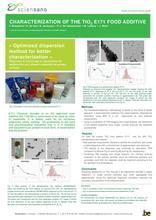
    E171 (Titanium dioxide) is an EC approved food additive (EC 1129/2011), authorized to be used as color in foodstuffs. It is widely used for its refractive properties (shiny coating, UV protection) in the food and pharmaceutical industries. It is intended and assumed to be present in bulk form. A nanofraction may be present.Dispersion is crucial step to characterize the particle properties of food additives as it allows to separate the primary particles. To better characterize titanium dioxide food additives (E171) their dispersion method was optimized.

    A dispersion methodology based on the Guiot and Spalla approach was applied. It electrosterically stabilizes the (nano)materials, dispersed by sonication, using BSA at a pH determined by zeta potential measurement. Dispersion efficiency was examined by descriptive TEM and using a combination of TEM imaging and image analysis. The latter approach allows to assess the distribution of the particle properties (size, shape, surface structure) quantitatively. For both the pristine TiO2 food additive E171 and the JRC TiO2 representative test material zeta-potential measurement allowed to identify the conditions (pH) where a stable dispersion with a minimal level of agglomeration was observed. The stability of the dispersion was confirmed by descriptive TEM: preparing dispersions of TiO2 through a pH adjustment provides a stable dispersion of single primary particles and small aggregates and agglomerates.

    Under the optimized conditions, the minimal external dimension of the primary particles could be measured more precisely and accurately by a combination of EM imaging and image analysis than in metastable conditions, such that the materials could be better classified according to the EC definition of a nanomaterial.

    Associated health topics:

    Food consumption and food safety [7]

    Source URL:https://sciensano.be/en/biblio/characterization-tio2-e171-food-additive

    Links
    [1] https://sciensano.be/sites/default/files/poster_characterization_of_the_tio2_e171_food_additive_-_sciensano_format.pdf [2] https://sciensano.be/en/people/frederic-brassinne/biblio [3] https://sciensano.be/en/people/jan-mast/biblio [4] https://sciensano.be/en/projects/towards-a-toxicologically-relevant-definition-nanomaterials [5] https://sciensano.be/en/projects/implementation-and-validation-analytical-methodology-assess-nanofraction-food-additives-e171-e174 [6] https://sciensano.be/en/projects/physico-chemical-characterisation-and-exposure-analysis-nanoparticles-food-additives-context-risk [7] https://sciensano.be/en/health-topics/food-consumption-and-food-safety